I write my own work, but I sometimes use AI to improve grammar, structure or clarity. That raised a practical question: could polishing a genuinely human draft make it look AI-generated?
I did not want to upload private work to another online service or rely on a single unexplained score. So I built a checker that runs on my home PC and lets me compare my original draft with the polished version, passage by passage.
What I built
The tool reads Word, PDF and text files, then evaluates each passage with two open-source detection methods. The report uses three simple outcomes: green when both read the passage as human, amber when one raises a warning and red when both flag it.
The most useful feature is its comparison mode. It does not simply ask whether a document looks human or artificial. It shows whether the editing process moved my writing towards a more AI-like pattern.
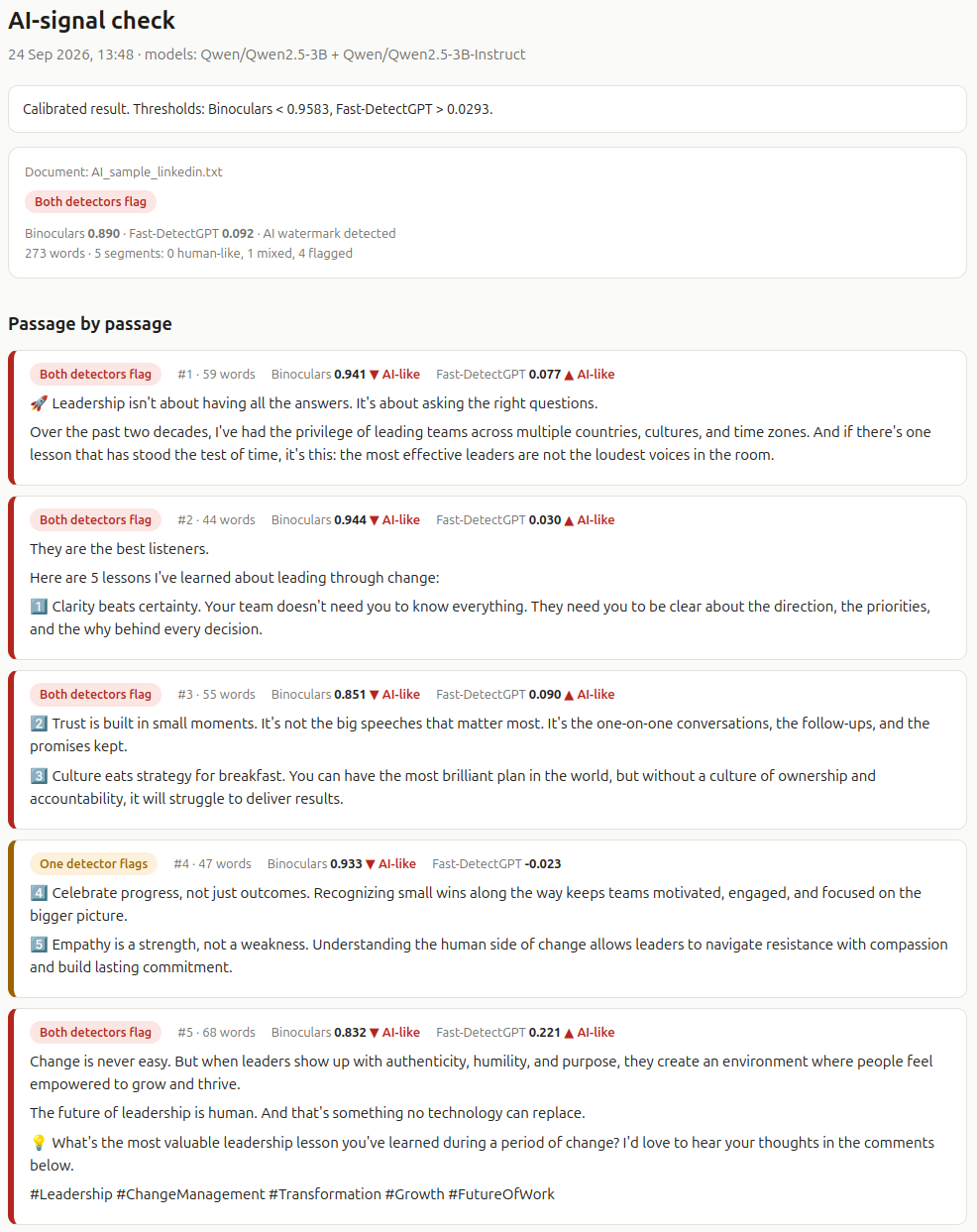
The result that mattered
Light polishing made almost no difference. My original essay and the version with small grammar and wording improvements both read as human.
My voice stayed intact
Original draft: 1.059 / −0.106
AI-polished draft: 1.050 / −0.085
Both detectors flagged it
An AI-rewritten personal story scored 0.877 / 0.073.
The distinction was clear. Asking AI to fix a sentence preserved my patterns. Asking it to rewrite a personal story replaced them with smoother, more predictable language and triggered both detectors.
How it works, in plain English
AI-generated text is often more statistically predictable than human writing. The two detectors examine that predictability in different ways. Binoculars compares how two language models interpret the surprise in a passage. Fast-DetectGPT looks at whether the selected words consistently resemble a model’s safest choices.
Both methods run locally using two small models from the Qwen family. Loading them in a compressed format means the complete check can run privately on an 8GB graphics card without sending the document elsewhere.
The first version was not good enough
The first build used smaller models. It separated human and AI writing weakly, but an obviously artificial essay still passed as human. That was more valuable than a convenient early success because it showed why AI tools need to be challenged with known examples rather than trusted because they produce a confident result.
I moved to larger models and calibrated the thresholds using 360 passages from MAGE, a public research dataset containing human and machine-generated writing. In that test, the final thresholds identified about 85% of the AI passages while flagging about 10% of human passages.
Signals, not proof
No AI detector can prove who wrote something. This tool does not reproduce Turnitin or any other proprietary system, and it should not be used to accuse someone of misconduct.
- A human passage can still trigger a warning.
- Formal and reflective writing often sits close to the boundary.
- Short passages are unreliable, so the tool groups them before scoring.
- Newer models and different writing styles may produce different results.
That is why I treat a single warning as information, not a verdict. The comparison between my own draft and its edited version is more useful than an isolated score.
What I took from it
The experiment produced a practical rule for my own work: accept useful edits one at a time, keep the original detail and sentence rhythm, and retain drafts and version history. Following the relevant disclosure rules is more meaningful protection than trying to satisfy a detector.
It also showed how capable local AI has become. A mid-range gaming graphics card can now run research-based detection privately. The technology is accessible. The harder task is designing an honest test, recognising uncertainty and deciding what the result is actually good for.