I began Cambridge Judge Business School’s Strategic Thinking for the CXO: Platforms, Ecosystems and AI-Driven Strategies programme looking for better answers.
Six weeks later, I left with better questions.
That might seem an unusual measure of success. In leadership, however, the quality of the decisions we make is often determined by the quality of the questions we ask first.
The danger of having an answer too quickly
Complex organisations naturally reward decisiveness. When performance is under pressure or transformation is falling behind, leaders are expected to provide direction.
But moving quickly towards an answer can mean solving the problem as it was initially presented—not necessarily the problem the organisation actually has.
An operational issue may be a symptom of an unclear operating model. A technology gap may reveal a weakness in process ownership. Resistance to change may reflect competing incentives rather than a lack of engagement.
Strategic thinking creates the space to step back and examine the wider system before deciding how to intervene.
From individual businesses to connected systems
The programme reinforced how platforms, ecosystems and AI are changing the context in which strategic choices are made.
Organisations no longer create value entirely within their own boundaries. Their performance increasingly depends on networks of customers, partners, suppliers, technology providers and data flows. AI adds another dimension by changing how decisions are supported, work is organised and value can be created.
This makes it important to ask questions such as:
- What system are we really trying to change?
- Which assumptions are shaping our current response?
- Where is value being created—and where is it being lost?
- What capabilities genuinely differentiate us?
- Where should we choose not to compete?
- How will the operating model turn the strategy into repeatable execution?
These questions do not remove uncertainty. They make it more visible and therefore more manageable.
Strategy becomes real through execution
For operations and transformation leaders, this matters because strategy only creates value when it changes what the organisation does.
That means translating ambition into clear accountabilities, practical governance, aligned measures and decisions that teams can execute consistently. It also means recognising that technology—including AI—cannot compensate for unclear ownership or a fragmented operating model.
The strategic question is therefore not simply, “What could this technology do?”
It is, “What should change in the business, and what would need to be true for that change to succeed?”
A more useful measure of learning
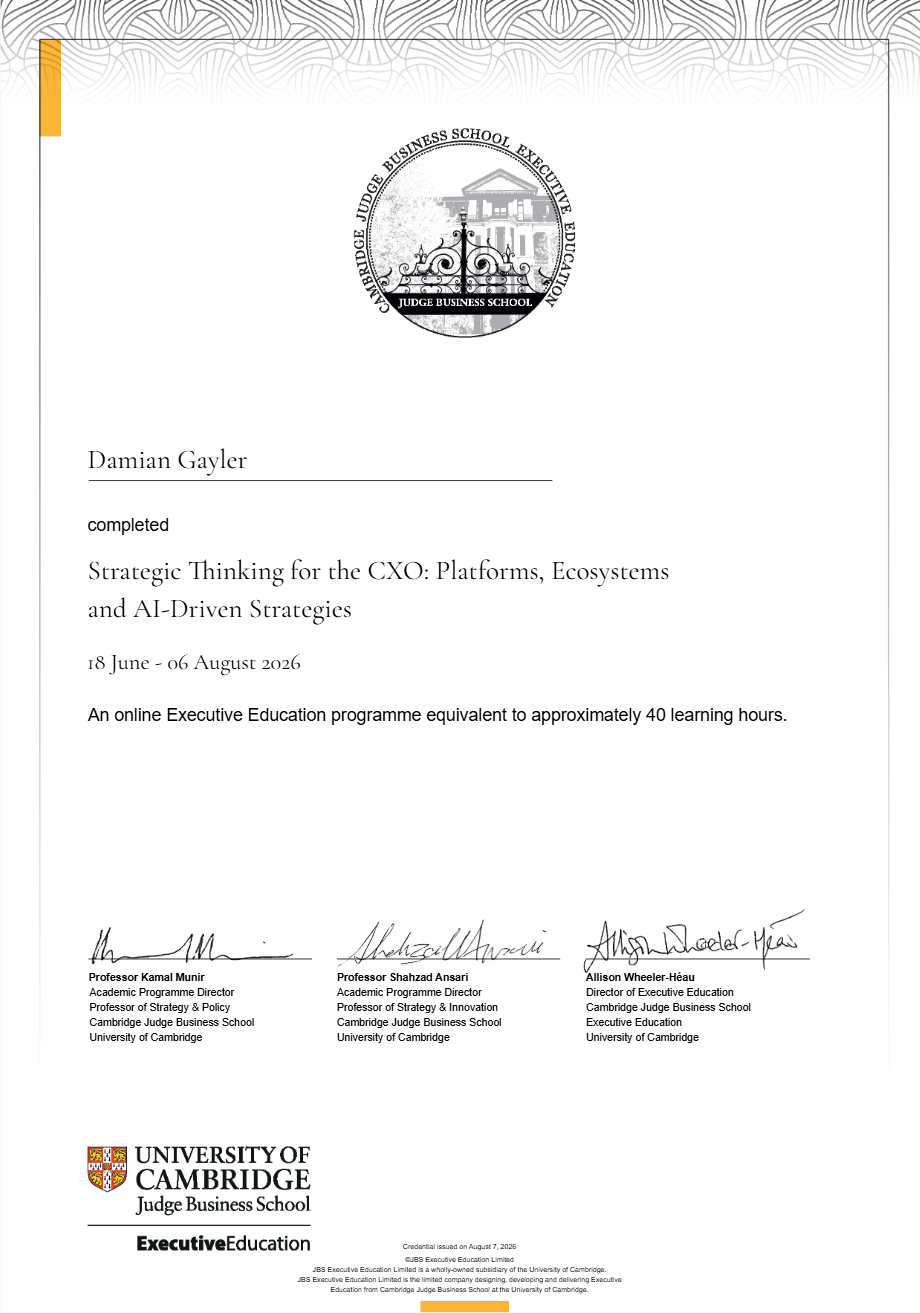
The certificate marks the completion of the programme. The more valuable outcome is a stronger way of examining complex choices: seeing the wider system, challenging assumptions and resisting the temptation to settle for the first convincing answer.
Good leadership is not about having an answer for everything.
Sometimes, the most strategic contribution a leader can make is to ask the question that changes how everyone sees the problem.